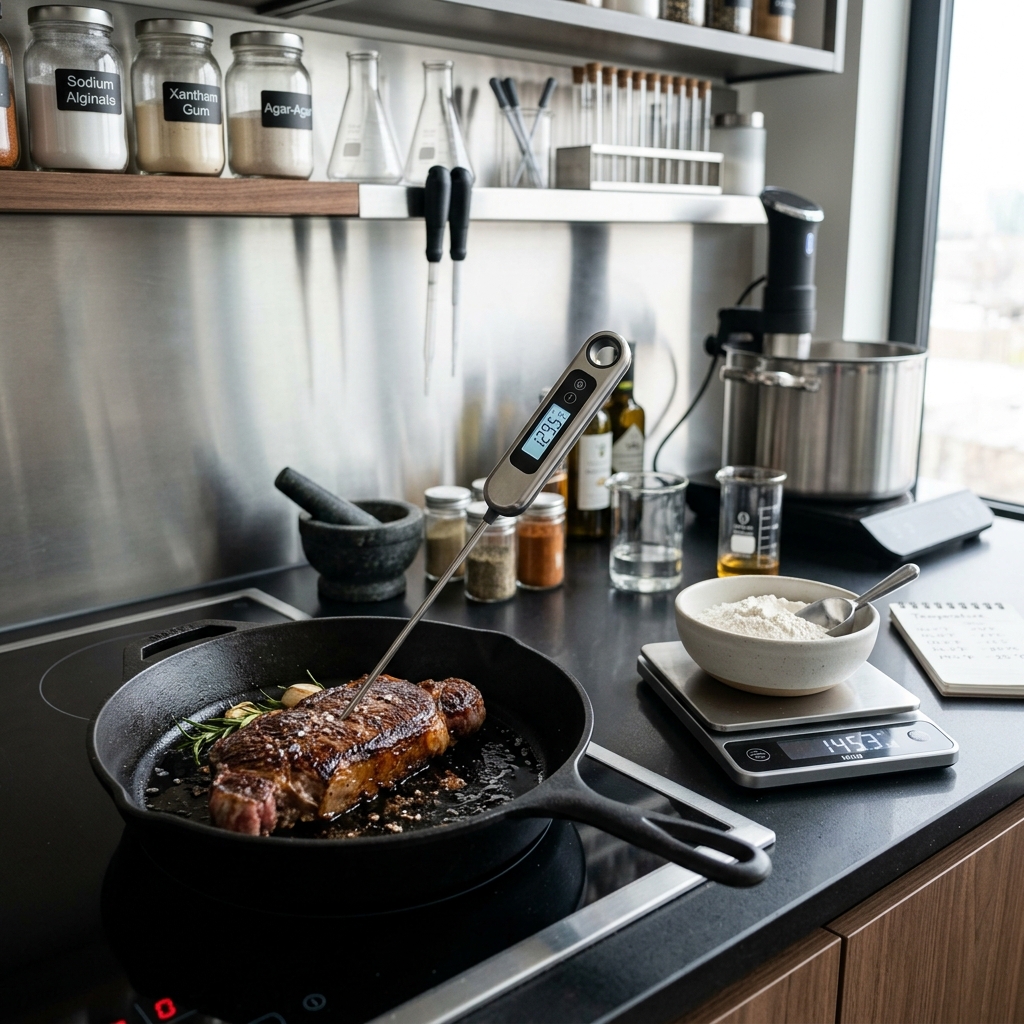
Cooking is simply the application of thermodynamics to edible matter. In 2026, the best chefs are using the physics of heat transfer—Conduction, Convection, and Radiation—to achieve perfect textures. Understanding the math of the kitchen means you never have to "guess" if a steak is done.
The Surface Area to Volume Ratio
The most important mathematical concept in roasting is the Surface-Area-to-Volume (SA:V) ratio. Small cubes of potatoes have a much higher SA:V than a whole potato, allowing for more "Maillard Reaction" (browning) per gram of food. This is why smaller cuts cook faster and have more flavor per bite.
Newton's Law of Cooling
When you take a roast out of the oven, it doesn't stop cooking. This is "Carryover Cooking." The rate of temperature change is proportional to the difference between the food and the room air:
This explains why resting meat is essential—it allows the internal temperature gradient to equalize without losing moisture.
Emulsions: The Math of Micelles
Making a vinaigrette or a hollandaise is an exercise in fluid dynamics. You are creating a stable suspension of oil in water. The math of the "Hydrophilic-Lipophilic Balance" determines whether your sauce will stay creamy or "break" into a greasy mess.