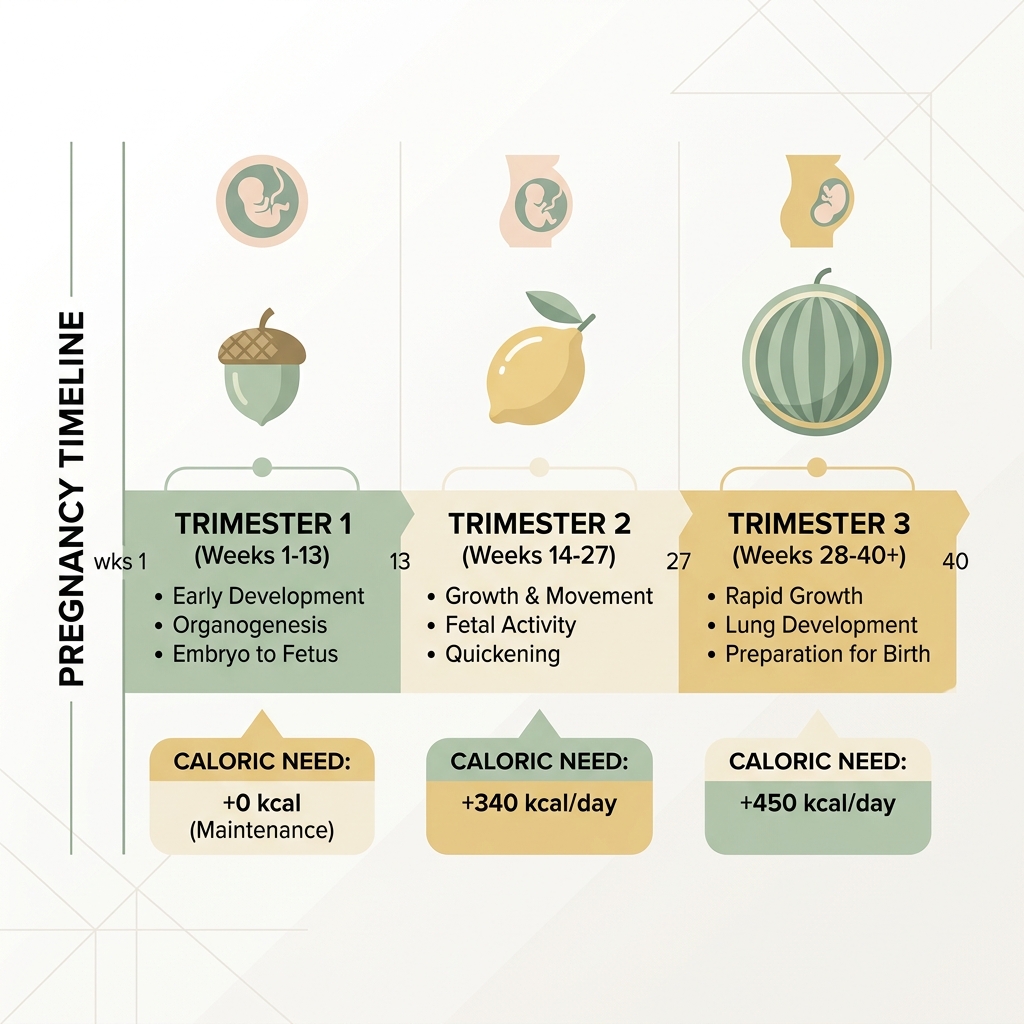
Pregnancy is a 40-week masterclass in exponential biological growth. However, the most famous number in pregnancy—the "Due Date"—is a statistical outlier. Only about 4% of babies are born on their exact due date. Understanding the math of gestation helps parents manage expectations and understand the normal variance of fetal development.
Naegele's Rule and Gestational Age
The standard method for calculating a due date is Naegele's Rule. It assumes a 28-day cycle and ovulation on day 14. The math is simple but based on averages:
Where LMP is the date of your Last Menstrual Period.
The Math of Fetal Weight Gain
Fetal growth is non-linear. In the first trimester, growth is measured in millimeters. By the third trimester, the baby is gaining roughly 200g (0.5 lbs) per week. This rapid acceleration of mass requires a mathematical adjustment in the mother's TDEE—typically an extra 300-500 calories per day by the final months.
Interpreting Statistical Risk
During pregnancy, you will be presented with many "risk ratios" (e.g., 1 in 500). It's important to distinguish between Relative Risk and Absolute Risk. A "doubling of risk" sounds terrifying, but if the absolute risk moves from 0.01% to 0.02%, the probability of a healthy outcome remains 99.98%.