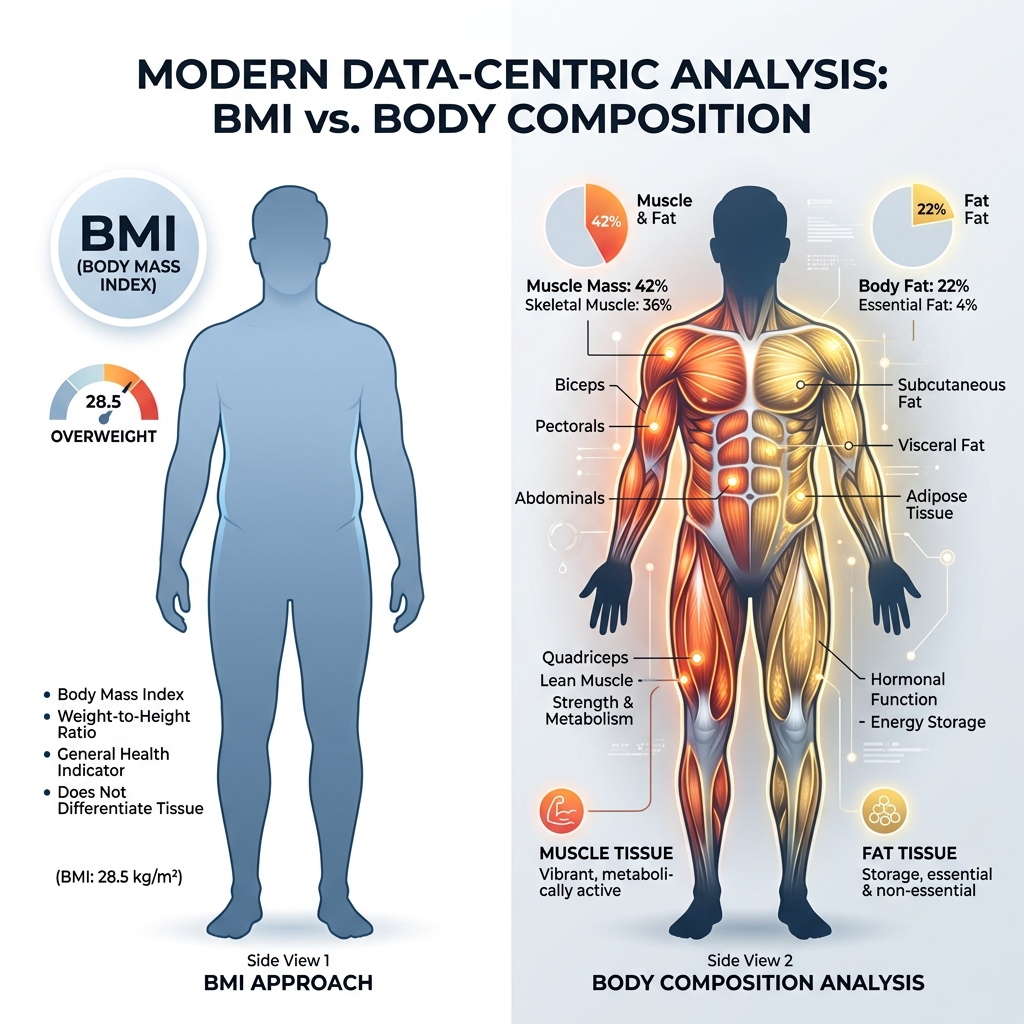
The number on your bathroom scale is the least important data point in your fitness journey. In 2026, health science has moved toward "Body Composition"—the ratio of Lean Mass to Fat Mass. You can weigh the same as someone else but have a radically different health profile based on your body fat percentage.
Why BMI Fails the Individual
Body Mass Index (BMI) is a population-level tool. It fails individuals because it does not distinguish between muscle and fat. An athlete with high muscle mass might be classified as "Obese" by BMI, while a "Skinny Fat" individual with low muscle mass might be classified as "Healthy" despite having metabolic risks.
The US Navy Method: Precision at Home
While DEXA scans are the gold standard, the US Navy Circumference Method is surprisingly accurate (within 3%). It uses your height and measurements of your neck, waist, and (for women) hips to estimate density.
The 'Essential Fat' Threshold
It is dangerous to aim for 0% body fat. Your body requires "Essential Fat" for hormonal function and vitamin absorption. For men, this is roughly 2-5%; for women, it's 10-13%. Dropping below these levels can lead to severe metabolic damage and long-term health issues.